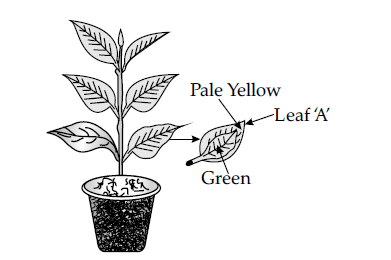
A potted plant with variegated leaves was taken in order to prove a factor necessary for photosynthesis. The potted plant was kept in the dark for 24 hours and then placed in bright sunlight for a few hours. Observe the diagram and answer the questions: A potted plant with variegated leaves was taken in order to prove a factor necessary for photosynthesis. The potted plant was kept in the dark for 24 hours and then placed in bright sunlight for a few hours. Observe the diagram and answer the questions:
Draw a neat labelled diagram of a chloroplast.
Topic: Chloroplast — diagram
Answer
Your diagram must show: • a DOUBLE MEMBRANE (outer and inner) enclosing the organelle • STROMA — the colourless fluid matrix filling it • GRANA — stacks of disc-like membranes, drawn as piles of coins • THYLAKOID — one individual disc within a granum • FRET (stroma lamellae) — the membranes connecting one granum to another
Labels required: double membrane, stroma, granum, thylakoid, fret.
THE FEATURE THAT MUST BE RIGHT is the GRANA, drawn as stacks of discs like piles of coins, joined to one another by FRETS. A chloroplast drawn as a plain oval with dots is not a chloroplast diagram.
WHY THE STRUCTURE LOOKS LIKE THIS — worth a line beside the diagram: the GRANA hold the CHLOROPHYLL and are where the LIGHT reaction happens. Stacking the membranes into discs packs an enormous surface area into a small volume, maximising light absorption. the STROMA is where the DARK reaction happens — it contains the enzymes that fix carbon dioxide into glucose.
So the two stages of photosynthesis occur in two different parts of the SAME organelle, and a labelled diagram shows exactly where.