The diagrams given below represent the relationship between a mouse and a physiological process that occurs in green plants. Bell jar A contains a mouse with a green plant; bell jar B contains a mouse with a burning candle and no plant. Study the diagrams and answer the questions that follow: The diagrams given below represent the relationship between a mouse and a physiological process that occurs in green plants. Bell jar A contains a mouse with a green plant; bell jar B contains a mouse with a burning candle and no plant. Study the diagrams and answer the questions that follow:
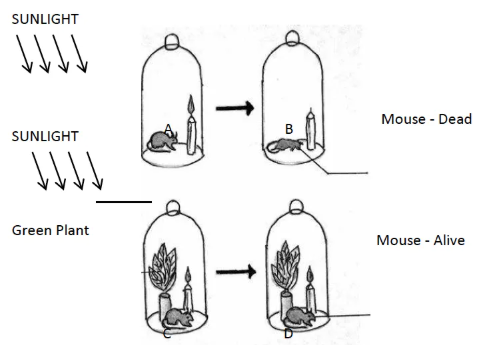
Represent the above mentioned physiological process in the form of a chemical equation.
Topic: Equation for photosynthesis
Answer
6CO₂ + 12H₂O → C₆H₁₂O₆ + 6H₂O + 6O₂↑
(in the presence of LIGHT ENERGY and CHLOROPHYLL, written above and below the arrow)
LIGHT ENERGY and CHLOROPHYLL are CONDITIONS, not reactants — write them on the arrow, never on the left-hand side. Mark the ↑ after O₂ to show a gas is released.
WHY 12 WATER AND NOT 6: the simpler form balances arithmetically but is chemically misleading. Twelve molecules are split during PHOTOLYSIS and six are re-formed in the dark reaction, which is why water appears on BOTH sides.
It also makes the point this whole experiment rests on: the oxygen released comes from WATER, not from carbon dioxide — proved using radioactive oxygen-18 as a tracer.