In the combinations of resistors shown below. calculate:
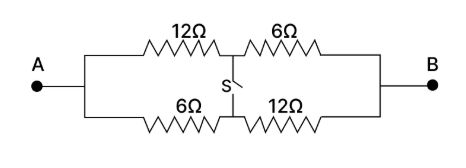
the resistance across AB when the switch S is closed.
Topic: Resistor network with a closed switch
Answer
With the switch S CLOSED, the two mid-points are joined into a single node, call it M. Redraw the network around that node.
Between A and M: the 12 Ω of the top branch and the 6 Ω of the bottom branch are now in parallel. R₁ = (12 × 6) ÷ (12 + 6) = 72 ÷ 18 = 4 Ω
Between M and B: the 6 Ω of the top branch and the 12 Ω of the bottom branch are in parallel. R₂ = (6 × 12) ÷ (6 + 12) = 72 ÷ 18 = 4 Ω
These two groups are in series between A and B: R = R₁ + R₂ = 4 + 4 = 8 Ω
Resistance across AB with S closed = 8 Ω
Closing a switch adds no resistor — it changes which resistors are connected to which, so redraw the network before you calculate anything.
The closed switch ties the two mid-points into one node M. That regroups the resistors completely: instead of two series branches of 18 Ω each, you now have the 12 Ω and 6 Ω on the LEFT of M in parallel (4 Ω), and the 6 Ω and 12 Ω on the RIGHT of M in parallel (4 Ω), with those two groups in series.
Note which resistors pair up. The left-hand pair is one 12 Ω and one 6 Ω, taken from DIFFERENT branches — not the two 12 Ω, which sit on opposite sides of M and never meet. Pairing them by value rather than by position is the usual error here.
The resistance falls from 9 Ω to 8 Ω when S is closed, which makes sense: joining the mid-points gives the current extra routes, and more paths always means less resistance. If your closed-switch answer came out larger than 9 Ω, the grouping is wrong. Sketching the redrawn circuit with M marked takes thirty seconds and prevents almost every mistake in switch questions.