The diagram below shows the ray OP travelling through an equilateral prism of a certain material.
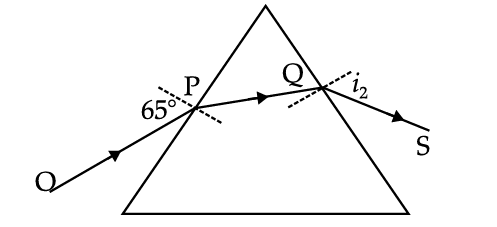
Calculate the value of i2, if the angle of deviation is 43°.
Topic: Prism deviation
Answer
Given: equilateral prism, so the angle of the prism A = 60°
angle of incidence i₁ = 65°, angle of deviation δ = 43°
For a prism: δ = i₁ + i₂ − A
43 = 65 + i₂ − 60 43 = 5 + i₂ i₂ = 43 − 5 i₂ = 38°
Value of i₂ = 38°
"Equilateral prism" is doing real work in this question: it tells you the refracting angle A is 60°, which is not given anywhere else. Every angle of an equilateral triangle is 60°.
Substitute into δ = i₁ + i₂ − A and rearrange carefully. The signs trip people up: A is SUBTRACTED, so moving it across makes 65 − 60 = 5, and i₂ = 43 − 5 = 38°.
Here i₂ (38°) differs from i₁ (65°), which tells you the ray is not passing symmetrically — so this is not the minimum-deviation position. At minimum deviation the two would be equal.