The diagram above shows three resistors connected across a cell of e.m.f. 1.8 V and internal resistance r. Calculate :
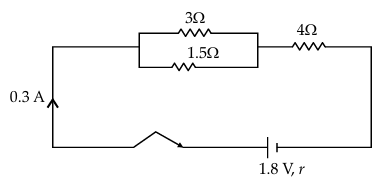
Current through 3 W resistor.
Topic: Current, resistance and circuits
Answer
From the circuit, the 3 Ω and 1.5 Ω are in parallel, and that combination is in series with the 4 Ω and the cell's internal resistance r.
Step 1 — the parallel pair: R_p = (3 × 1.5) ÷ (3 + 1.5) = 4.5 ÷ 4.5 = 1 Ω
Step 2 — the main current. From part (ii) the internal resistance is 1 Ω, so I = ε ÷ (4 + R_p + r) = 1.8 ÷ (4 + 1 + 1) = 1.8 ÷ 6 = 0.3 A
Step 3 — the voltage across the parallel section: V_p = I × R_p = 0.3 × 1 = 0.3 V
Step 4 — the current through the 3 Ω resistor. Resistors in parallel share the same voltage: I₃ = V_p ÷ 3 = 0.3 ÷ 3 = 0.1 A
Current through the 3 Ω resistor = 0.1 A
The whole method rests on one rule: resistors in PARALLEL have the same VOLTAGE across them, while resistors in SERIES carry the same CURRENT. So find the voltage across the parallel section, then divide by each resistance separately.
The main current does NOT all go through the 3 Ω. It splits, and the larger resistance takes the smaller share: 0.1 A through the 3 Ω and 0.2 A through the 1.5 Ω, adding back to 0.3 A ✓. Assuming the whole 0.3 A flows through the 3 Ω is the commonest mistake here.
That check at the end — the branch currents must add up to the main current — costs nothing and catches most errors.