The diagram shows a circuit with the key k open. Calculate:
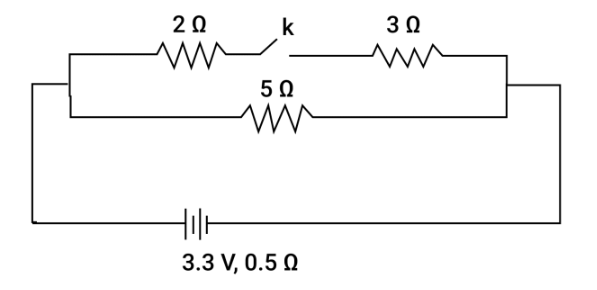
the resistance of the circuit when the key k is closed.
Topic: Current, resistance and circuits
Answer
With the key k closed, the branch containing the 2 Ω and 3 Ω now carries current.
Step 1 — that branch is a series pair: R₁ = 2 + 3 = 5 Ω
Step 2 — it is in parallel with the other 5 Ω: R_ext = (5 × 5) ÷ (5 + 5) = 25 ÷ 10 = 2.5 Ω
Step 3 — add the internal resistance: total = 2.5 + 0.5 = 3 Ω
Total resistance of the circuit = 3 Ω
Closing the key brings a whole branch into play, so the resistance DROPS — from 5.5 Ω to 3 Ω. That is worth checking: adding a parallel path always lowers the total resistance, never raises it. If your closed-key answer came out bigger than the open-key one, you have added the branch in series by mistake.
Two equal resistors in parallel give exactly half of one of them: 5 Ω and 5 Ω give 2.5 Ω. Worth remembering as a shortcut. Then the internal 0.5 Ω goes on at the end, in series as always.