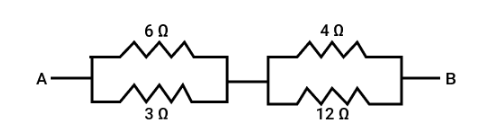
Find the equivalent resistance between A and B
Topic: Current, resistance and circuits
Answer
From the circuit, the 6 Ω and 4 Ω are in series in one branch, the 3 Ω and 12 Ω are in series in the other, and the two branches are in parallel between A and B.
Upper branch (series): R₁ = 6 + 4 = 10 Ω
Lower branch (series): R₂ = 3 + 12 = 15 Ω
The two branches in parallel: R = (R₁ × R₂) ÷ (R₁ + R₂) = (10 × 15) ÷ (10 + 15) = 150 ÷ 25 = 6 Ω
Equivalent resistance between A and B = 6 Ω
Work inwards. Reduce each branch to a single resistor first, then combine what is left. Trying to do the whole network in one formula is where circuit questions go wrong.
Check the answer against the rule: a parallel combination must be smaller than the smaller branch. 6 Ω is less than 10 Ω ✓. If you had got 25 Ω you would have added everything in series and missed the parallel arrangement entirely.
The product-over-sum shortcut, R = R₁R₂/(R₁+R₂), works for exactly TWO resistors in parallel. For three or more, go back to 1/R = 1/R₁ + 1/R₂ + 1/R₃.