Richa weighing 40 kgf leaves point P on her skateboard and reaches point Q on the ground with velocity 10 ms-1. Calculate.
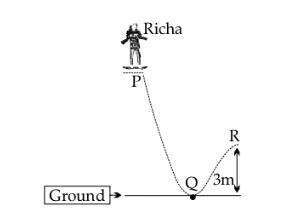
the kinetic energy of Richa at point R. (While moving from Q to R, she loses 500 J of energy against friction.)
Topic: Energy loss due to friction
Answer
Given: KE at Q = 2 000 J; R is 3 m above the ground; 500 J lost to friction between Q and R; m = 40 kg, g = 10 m s⁻².
Going from Q to R, the 2 000 J of kinetic energy is spent in two ways: some is converted into potential energy as she rises, and some is lost to friction.
Potential energy gained at R: PE = m g h = 40 × 10 × 3 = 1 200 J
Energy lost to friction = 500 J
Kinetic energy remaining at R: KE_R = KE_Q − PE gained − energy lost to friction = 2 000 − 1 200 − 500 = 300 J
Kinetic energy of Richa at R = 300 J
Treat it as a budget. She starts with 2 000 J of kinetic energy at Q; 1 200 J is spent climbing to R and 500 J is spent against friction, so 300 J is left as kinetic energy.
Both subtractions are needed. Forgetting the friction gives 800 J; forgetting the height gives 1 500 J. Neither is right, because both are genuine claims on the same 2 000 J.
Friction always takes energy AWAY, so it is always subtracted — it never helps her along. Setting out the three lines as an energy budget makes it obvious where each joule has gone, and is worth doing even when you can see the answer.