Akash takes a uniform metre scale and suspends a weight of 2 N at one end ‘X’, and a weight of 5 N on the other end ‘Y”. He then balances the ruler horizontally on a knife edge placed at 70 cm from X. Draw a diagram of the arrangement and calculate the weight of the ruler.
Topic: Principle of moments
Answer
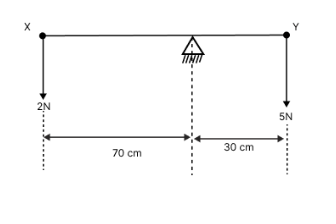
Given: a uniform metre scale with 2 N at end X (the 0 cm mark) and 5 N at end Y (the 100 cm mark), balanced on a knife edge 70 cm from X.
The scale is uniform, so its whole weight W acts at the 50 cm mark.
Distances from the knife edge (at the 70 cm mark):
the 2 N weight at 0 cm → 70 cm away, on the X side
the weight W at 50 cm → 20 cm away, on the X side
the 5 N weight at 100 cm → 30 cm away, on the Y side
By the principle of moments: moments on the X side = moments on the Y side (2 × 70) + (W × 20) = 5 × 30 140 + 20W = 150 20W = 150 − 140 20W = 10 W = 10 ÷ 20 W = 0.5 N
Weight of the metre scale = 0.5 N
Three forces act, not two — the scale's own weight is the third, and it acts at the 50 cm mark because the scale is uniform. Forgetting it makes the equation 2 × 70 = 5 × 30, which is 140 = 150 and simply does not balance. That contradiction is the clue that a force is missing.
Work out every distance as a GAP from the knife edge at 70 cm: 70 − 0 = 70, 70 − 50 = 20, and 100 − 70 = 30. Using the position marks themselves is the usual error.
The scale's weight sits on the same side as the 2 N, so it joins that side of the equation. Draw the diagram the question asks for and mark the three distances on it — the marks are there for the diagram as well as the arithmetic.