NumericalHard4 marks
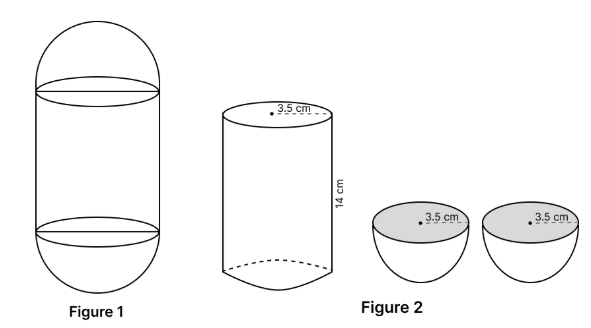
A solid wooden capsule is shown in Figure 1. The capsule is formed of a cylindrical block and two hemispheres. Find the sum of total surface area of the three parts as shown in Figure 2. Given, the radius of the capsule is 3.5 cm and the length of the cylindrical block is 14 cm. (Use π = 22/7 )
Topic: Mensuration of solids
Previous-year question practice database
Answer
Exam answer
Given: r = 3.5 cm, h = 14 cm, π = 22/7.
Total surface area of cylinder = 2πr(h+r) = 2 × 22/7 × 3.5 × (14+3.5) = 385 cm².
Total surface area of one hemisphere = 3πr² = 3 × 22/7 × (3.5)² = 115.5 cm².
For two hemispheres: = 231 cm².
Required sum = 385 + 231 = 616 cm².
Answer: 616 cm².
Explanation
The question asks for the sum of the total surface areas of the cylinder and both hemispheres as separate solids, so the circular faces are included in each individual Total surface area.
More from Cylinder, Cone and Sphere
The total surface area of a solid sphere (S1) and a solid hemisphere (S2), as shown in the diagram, are equal. The ratio of radii R and r is :2026minimum height of the cylindrical box required to pack this bottle.2026volume of the liquid medicine (shaded part) in the bottle. Give your answer to the nearest whole number. (Use π = 22/7 )2026the total surface area of the given solid.2026the cost of painting the total surface at the rate of ₹0.50 per cm.2026If the volume of two spheres is in the ratio 27: 64, then the ratio of their radii is:2025