NumericalModerate2 marks
2(ii)
A solid metallic cylinder is cut into two identical halves along its height. The diameter of the cylinder is 7 cm and the height is 10 cm. Find :
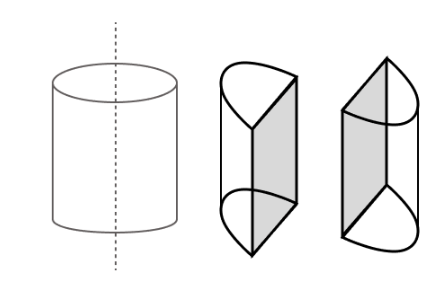
The total surface area (both the halves).
Topic: Mensuration
Previous-year question practice database
Answer
Exam answer
437 cm2.
Explanation
Given, Diameter of cylinder (d) = 7 cm Radius of cylinder (r) = d/2 = 7/2 = 3.5 cm Height of cylinder (h) = 10 cm Total surface area (both the halves) = Total surface area of cylinder + Area of two rectangles = [2 * π * r * (h + r)] + [2 * (l * b)] = [2 * π * r * (h + r)] + [2 * (h * d)] = [2 * (22/7) * 3.5 * (3.5 + 10)] + [2 * 10 * 7] = (2 * 22 * 0.5 * 13.5) + 140 = 297 + 140 = 437 cm2. Hence, total surface area of both the halves = 437 cm2.
More from Cylinder, Cone and Sphere
The total surface area of a solid sphere (S1) and a solid hemisphere (S2), as shown in the diagram, are equal. The ratio of radii R and r is :2026minimum height of the cylindrical box required to pack this bottle.2026volume of the liquid medicine (shaded part) in the bottle. Give your answer to the nearest whole number. (Use π = 22/7 )2026the total surface area of the given solid.2026the cost of painting the total surface at the rate of ₹0.50 per cm.2026If the volume of two spheres is in the ratio 27: 64, then the ratio of their radii is:2025